During the production phase of art assets, I prioritized the completion of 3D model resources for tomato plants at different growth stages. Based on the issues exposed during the early model testing, this production underwent systematic adjustments in terms of polygon count control and structural optimization, and modeling specifications were redefined based on the usability of real-time engines. During the production process, I continuously paid attention to the topological structure and polygon count of the model, ensuring it could better accommodate the subsequent procedural generation and batch instancing requirements.
On this basis, the tomato model is developed as a standard asset, providing a reference benchmark for the creation of other plant types in the future and enabling direct entry into the engine testing phase for verification.
In terms of animation implementation, since the number of plants will be generated programmatically, adopting a complex skeletal or growth animation system would significantly increase the system’s burden. Therefore, instead of continuing with the more complex research animation scheme from the previous stage, a lighter implementation approach was adopted in this phase. This approach involves controlling the scaling and morphological changes of the model through keyframes to simulate the transition effects of plants during different growth stages. While ensuring visual expression, this method effectively reduces computational costs and improves overall operational efficiency.
Adding some simple self-rotation won’t make it too monotonous
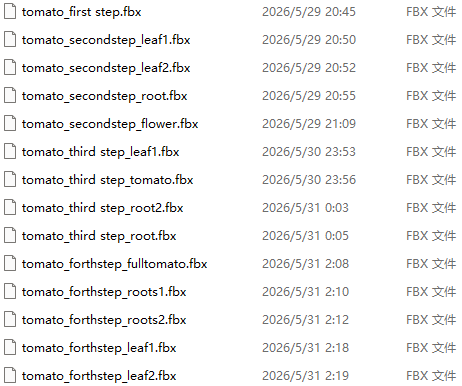
During the asset production process for tomato plants, I established models for different growth stages and simultaneously organized standardized naming conventions for files and resources at that stage. By setting unified naming conventions for model versions, stage divisions, and purposes, it made subsequent calls and tests in the engine clearer and more efficient.
Standardized naming not only enhances the readability of resource management but also mitigates potential confusion during program invocation and version switching. This step establishes a unified standard for the subsequent production of batch plant assets, thereby facilitating better organization and collaboration efficiency in the overall development process.
Leave a Reply